
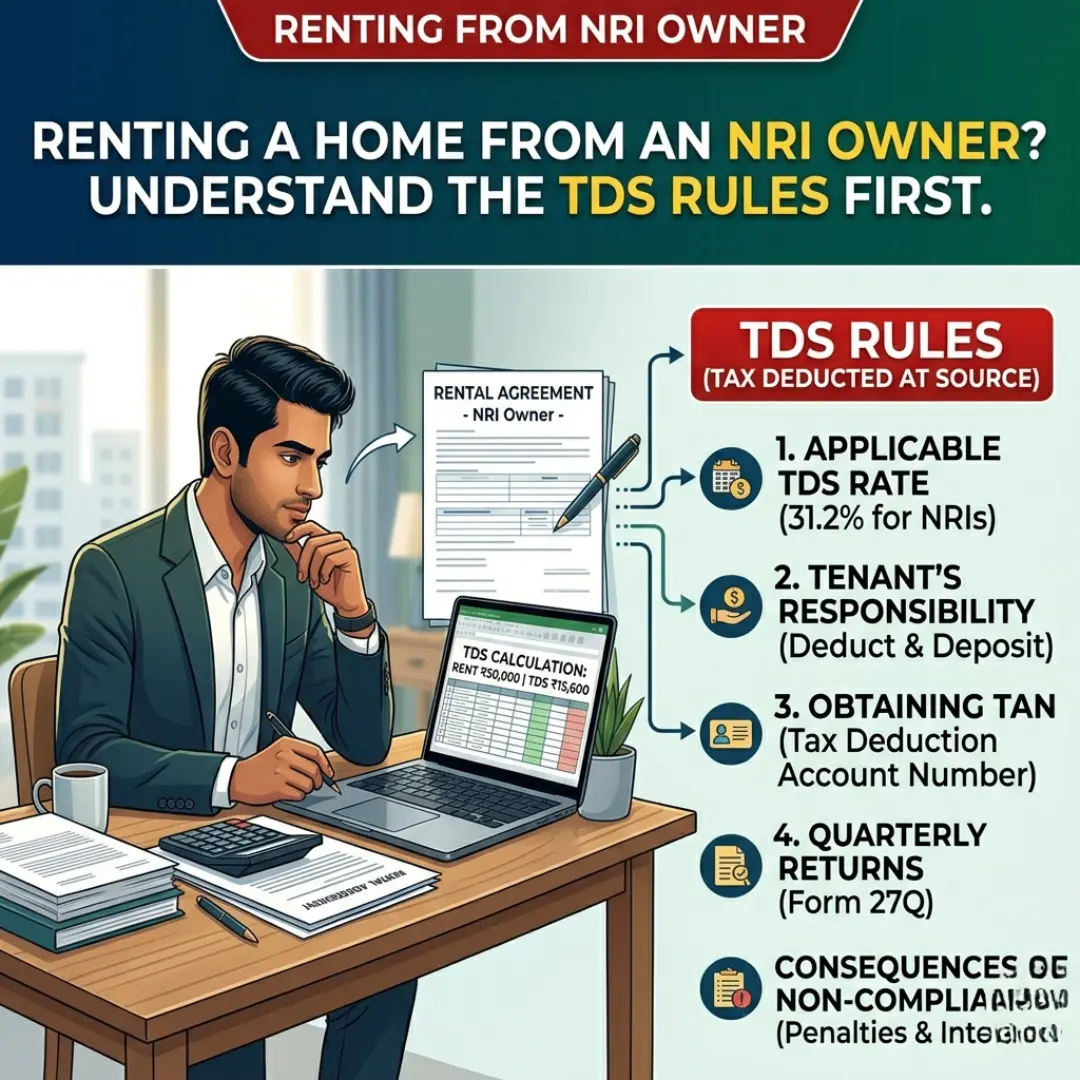
Finding the perfect home to rent in a bustling city like Bangalore can feel like searching for a needle in a haystack. You finally find a place that checks all the boxes—the right locality, the perfect balcony view, and a landlord who seems decent over the phone. But then, you discover the owner lives in Dubai or San Francisco. Suddenly, you aren’t just a tenant; you are a tax collector for the Indian government.
Let’s be real, nobody likes tax complications, especially not when you are just trying to settle into a new home. If you are considering Renting property from NRI, you cannot just sign the lease, hand over the security deposit, and call it a day. The Indian Income Tax Act has strict provisions, and failing to follow the NRI landlord TDS rules can land you in some serious hot water.
In this comprehensive guide, we are going to break down everything you need to know about deducting tax at source on your rent. We will explore why the government does this, how much you need to deduct, the exact step-by-step process, and the penalties for getting it wrong. And since we are talking about navigating the complex world of real estate—whether renting or buying—we will also explore why sometimes, the best way to avoid landlord headaches altogether is to own your own space, particularly in prime areas like Yelahanka, where exceptional projects like SLV Golden Tower are redefining city living.
The Core Concept: Why is Rent from an NRI Taxed Differently?
Before we dive into the deep end, let’s understand the “why.” When you pay rent to a resident Indian landlord, the tax liability is on them. They earn the income, they report it, and they pay the tax. The government trusts them to do this. However, when the landlord is a Non-Resident Indian, the scenario changes entirely.
Any income that an NRI earns from sources within India—be it rent, interest, or professional fees—is subject to TDS before it leaves the country. The government wants to ensure that tax is collected on this income right at the source, rather than chasing an individual across international borders later.
Therefore, the responsibility shifts from the landlord to the tenant. As a tenant, you become the “deductor.” You are legally obligated to deduct the tax and deposit it with the government before transferring the remaining rent to your NRI landlord. Understanding NRI landlord TDS rules is not optional; it is a legal mandate under Section 195 of the Income Tax Act.
The Magic Number: How Much TDS Should You Deduct?
This is where most tenants get a rude awakening. If you were paying rent to a resident Indian, you wouldn’t have to worry about TDS unless your rent exceeded ₹50,000 per month (under Section 194-IB, where TDS is a flat 5%).
But for an NRI landlord, TDS on rent paid to NRI is a completely different ballgame. There is no threshold limit. Even if your rent is ₹15,000 a month, TDS applies.
So, what is the rate? The standard TDS rate on rent paid to an NRI is a staggering 31.2% (30% base rate + 4% Health and Education Cess).
Yes, you read that right. If your rent is ₹1,00,000, you cannot just transfer ₹1,00,000 to your landlord. You have to deduct ₹31,200 and only transfer ₹68,800.
Wait, before you panic and start looking for a new apartment, there is a silver lining. The NRI landlord TDS rules allow the landlord to apply for a lower deduction certificate from the Income Tax Department. If the landlord’s total income in India falls within the taxable limit, or if their effective tax rate is much lower than 30%, they can apply under Section 197. If approved, the IT department will issue a certificate specifying a lower TDS rate (sometimes even 0%). As a tenant, you can then use this certificate to deduct tax at the lower rate. But until you have that certificate in your hands, the 31.2% rule applies by default.
Step-by-Step Guide: How to Actually Deduct and Deposit the TDS
Navigating NRI landlord TDS rules can feel like you are doing your CA’s job. But once you break it down, it is a systematic process. Here is what you need to do:
Step 1: Get a TAN (Tax Deduction Account Number)
Since you are deducting TDS under Section 195, you must have a TAN. It is a 10-digit alphanumeric code that identifies you as a tax deductor. You can apply for a TAN online through the NSDL website. Without a TAN, you cannot deposit the TDS or file the return.
Step 2: Calculate and Deduct the TDS
Calculate the TDS amount based on the agreed rent. If the landlord has provided a lower deduction certificate under Section 197, use the rate mentioned in that certificate. Deduct this amount from the monthly or agreed-upon rent.
Step 3: Deposit the TDS with the Government
You cannot just hold onto the deducted money. It must be deposited with the Income Tax Department. This is done using Form 281 through the NSDL portal. The deposit must be made by the 7th of the following month. For example, the TDS deducted for January must be deposited by February 7th.
Step 4: File TDS Returns
Paying the money isn’t enough; you have to report it. You need to file a TDS return using Form 27Q, which is specifically for TDS on payments to non-residents. This return details the landlord’s PAN, the amount paid, and the TDS deducted. This is usually filed quarterly.
Step 5: Issue Form 16A
Once the TDS return is processed, you need to download Form 16A from the TRACES portal. This is the TDS certificate that proves to your landlord that you have deducted and deposited the tax. You must issue this to the landlord so they can claim credit for this TDS when they file their own tax returns.
Common Mistakes Tenants Make (And How to Avoid Them)
When dealing with NRI landlord TDS rules, ignorance is definitely not bliss. Here are the most common pitfalls:
- Treating NRI Rent Like Resident Rent: The biggest mistake is assuming the 5% TDS rule (or no TDS rule) applies. Always verify your landlord’s residential status. Just because they have an Indian PAN card and an Aadhar card doesn’t mean they are a resident for tax purposes.
- Missing the 7th Deadline: Delaying the TDS deposit results in hefty interest charges. You will be liable to pay 1.5% interest per month or part of the month from the date of deduction to the date of payment.
- Ignoring Form 15CA and 15CB: If you are remitting the rent abroad (or even crediting it to their NRO account), you must fill out Form 15CA and get a Chartered Accountant to certify Form 15CB. These forms ensure that the TDS has been properly deducted before the funds leave the country.
The Hidden Headaches: Why Renting from an NRI Can Be Draining
Let’s step back from the tax forms for a moment and look at the practical reality. Complying with NRI landlord TDS rules is a massive administrative burden. You have to get a TAN, file quarterly returns, maintain meticulous records, and coordinate with your landlord for their PAN and lower deduction certificates.
Beyond the tax headache, the day-to-day realities of Renting property from NRI can be frustrating. Maintenance issues become a game of international phone tag. A leaking pipe or a faulty geyser requires permission from someone in a different time zone. Rent agreements need to be executed through a Power of Attorney (POA), which brings its own legal complexities. And let’s not forget, the landlord might decide to sell the property, leaving you scrambling for a new home.
When you weigh the cost of paying a CA to handle your TDS compliance, the stress of quarterly filings, and the lack of immediate control over maintenance, you have to ask yourself: Is renting really worth it?
This brings us to a crucial paradigm shift. What if, instead of dealing with complex NRI landlord TDS rules and paying off someone else’s mortgage, you invested that money into your own future?
The Shift: From Renter to Homeowner in Bangalore’s Hottest Market
Bangalore’s real estate market is booming. The city is the undisputed IT capital of India, attracting millions of professionals who initially come as renters. But as they settle into their careers and start families, the desire to own a piece of the city grows stronger. Real estate investment Bangalore has consistently proven to be a hedge against inflation and a reliable wealth-building tool.
When you own your home, you don’t have to worry about TAN numbers, Form 27Q, or a landlord living thousands of miles away. You are the master of your domain. And when it comes to Apartment investment in Bangalore, one locality has been consistently outperforming the rest: Yelahanka.
Why Yelahanka? The Crown Jewel of North Bangalore
If you have lived in Bangalore for any amount of time, you know that North Bangalore is the city’s future. Driven by the Kempegowda International Airport, the Aerospace SEZ, and massive infrastructure projects like the Peripheral Ring Road, this part of the city is exploding with potential.
Yelahanka, in particular, has transformed from a quiet suburban outpost into a thriving, self-sustaining micro-city. It offers the perfect balance—excellent connectivity to the airport and major tech parks via the National Highway 44 and the upcoming metro line, while still retaining its green cover and serene lakes.
The demand for Flats in Yelahanka has skyrocketed. Whether it’s young professionals looking for a well-connected starter home or families wanting a peaceful environment with top-tier schools and hospitals nearby, Yelahanka caters to everyone. Consequently, Yelahanka flats for sale are being snapped up by astute investors and end-users alike, making it the most promising destination for Bangalore real estate investments today.
Enter Globes Properties: Your Trusted Partner in Real Estate
Navigating the real estate market can sometimes feel as complicated as navigating NRI landlord TDS rules—but it doesn’t have to be. That’s where Globes Properties Bangalore steps in.
We believe that buying a home should be a joyous milestone, not a stressful transaction. Globes Properties real estate has built an unshakeable reputation on the pillars of transparency, quality, and customer-centricity. We don’t just build buildings; we craft communities. When you look at Globes Properties apartments, you will immediately notice the difference in design aesthetics, spatial planning, and structural integrity.
Globes Properties projects in Bangalore are strategically located in high-growth corridors to ensure that your investment yields substantial returns over time. Whether you are a first-time homebuyer or a seasoned investor, Globes Properties flats for sale offer a diverse portfolio to match your exact needs and budget. With a track record of timely delivery and uncompromising quality, Globes Properties Bangalore is the name you can trust with your life’s biggest investment.
The Masterpiece: SLV Golden Tower by Globes Properties
If you are ready to leave the rental market and its endless tax complications behind, Globes Properties apartments has a project that perfectly encapsulates luxury, comfort, and unparalleled value. Let us introduce you to the crown jewel of Yelahanka: SLV Golden Tower.
Situated in the heart of this vibrant locality, SLV Golden Tower is not just an apartment complex; it is a lifestyle upgrade. Designed for those who refuse to compromise on quality, this project offers a living experience that rivals the finest in the city.
The SLV Golden Tower Advantage
What makes this project the ultimate choice for Real estate investment Bangalore?
- World-Class Amenities: At SLV Golden Tower, your weekends will never be the same. Take a dip in the temperature-controlled swimming pool, break a sweat in the state-of-the-art gymnasium, or unwind in the lush, landscaped gardens. There’s a dedicated children’s play area, a multipurpose hall for your celebrations, and a serene senior citizen sit-out area.
- Unmatched Connectivity: Located in Yelahanka, the project offers seamless access to Hebbal, Manyata Tech Park, and the International Airport. You are just minutes away from top educational institutions like Canadian International School and hospital networks like Aster CMI.
- Impeccable Design: Whether you are looking for spacious 3bhk flats for sale in yalahanka or sprawling 4bhk flats for sale in Yalahanka, SLV Golden Tower has a floor plan tailored for your family. The apartments feature vastu-compliant layouts, cross-ventilation, premium fittings, and large balconies that offer breathtaking views of the city skyline.
- Luxury Redefined: When you search for luxury flats for sale in Yelahanka, you expect the best. SLV Golden Tower delivers with high-speed elevators, 24/7 multi-tier security with CCTV surveillance, power backup, and dedicated parking zones. It is a sanctuary of peace and exclusivity.
Comparing the Costs: Renting vs. Buying at SLV Golden Tower
Let’s do some quick math. Imagine you are paying a rent of ₹60,000 per month to an NRI landlord. Under the NRI landlord TDS rules (assuming a 31.2% rate without a lower deduction certificate), you would have to deduct ₹18,720 every month. On top of the rent you are paying, you are dealing with the administrative burden of depositing this tax and filing returns. Over 5 years, you will have paid ₹36 lakhs in rent and handled tax paperwork for nearly ₹11 lakhs in TDS—money that builds zero equity for you.
Now, consider taking that same budget and putting it toward an EMI for a 3bhk flat for sale in Yelahanka at SLV Golden Tower. Instead of dealing with landlords and Property tax rules India for someone else’s property, you are building your own asset. The property value in Yelahanka is appreciating at a rapid pace. Five years down the line, your investment in Globes Properties flats for sale will have grown significantly, while your rental property would have yielded absolutely zero returns.
Owning a home at SLV Golden Tower means:
- No TDS headaches: You are the owner. No PANs, no TANs, no Form 15CB.
- Freedom of customization: Paint the walls whatever color you want. Knock down a partition. It’s your home.
- Security: No fear of eviction. No rent hikes. No dealing with a Power of Attorney.
- Wealth Creation: Every EMI payment increases your equity in a high-value asset in a prime Bangalore locale.
Understanding the Bigger Picture: Tax Benefits of Buying Over Renting
While we have spent a lot of time discussing NRI landlord TDS rules, it’s only fair to talk about the tax benefits you receive when you buy a home instead of renting one. The government actually incentivizes homeownership through various deductions under the Income Tax Act:
- Section 80C: You can claim deductions of up to ₹1.5 lakhs on the principal repayment of your home loan.
- Section 24(b): You can claim a deduction of up to ₹2 lakhs on the interest paid on your home loan.
- Section 80EEA: If you are a first-time homebuyer and the stamp duty value of the property is under ₹45 lakhs, you can claim an additional deduction of ₹1.5 lakhs on home loan interest.
When you add up these tax savings, the cost of owning a home in SLV Golden Tower becomes far more economical than renting a similar property. You save on taxes just like you would have dealt with TDS while renting, but in this case, the savings go directly into your pocket, not the government’s coffers. This makes Apartment investment in Bangalore a brilliantly strategic financial move.
Why Globes Properties is the Only Choice for Your Dream Home
The journey from renter to homeowner is a monumental one, and choosing the right developer is half the battle won. Globes Properties real estate has a legacy of turning the dreams of thousands of families into reality. We understand that buying a home is an emotional decision as much as a financial one.
That’s why Globes Properties projects in Bangalore are built with a fierce attention to detail. From the quality of the cement to the finish on the bathroom tiles, no corner is cut. When you buy into Globes Properties apartments, you are buying into a promise—a promise of durability, aesthetics, and a vibrant community.
Our commitment doesn’t end at handing over the keys. Globes Properties Bangalore ensures meticulous post-handover maintenance, ensuring that SLV Golden Tower remains a premier address in Yelahanka for decades to come. Our transparent documentation processes are a breath of fresh air, especially if you are used to the convoluted paperwork of Renting property from NRI. We handle the complexities so you can focus on the joy of moving into your new home.
Making the Decision: Your Next Steps
So, where do you stand?
Are you going to continue dealing with the exorbitant TDS on rent paid to NRI, filing quarterly returns, and paying off someone else’s mortgage? Or are you ready to take control of your life and your finances?
The NRI landlord TDS rules exist for a reason, and if you must rent under such circumstances, compliance is non-negotiable. You must get your TAN, deduct the tax, and file your forms diligently. Ignorance of these NRI landlord TDS rules can lead to penalties that will far outweigh the cost of hiring a good CA.
However, if you are tired of the rental trap, the solution is right in front of you. The vibrant, flourishing community of Yelahanka is waiting. The meticulously crafted luxury flats for sale in Yelahanka at SLV Golden Tower offer a lifestyle that no rental apartment can match.
Take the leap. Explore the 3bhk flats for sale in yalahanka and 4bhk flats for sale in Yalahanka at this prestigious project. Experience the unmatched quality of Globes Properties flats for sale. Transform your hard-earned money from a tax liability into a tangible, appreciating asset.
Visit the Globes Properties Bangalore website today or contact our sales team to book a site visit for SLV Golden Tower. Step into the future of luxurious, independent living. Leave the landlord, the TAN, and the NRI landlord TDS rules behind, and unlock the door to your very own dream home. Because at the end of the day, the best tax planning is investing in yourself and your family’s future.
For More Visit: https://globesproperties.com/
Powered By: https://mnmreality.com/




Join The Discussion