
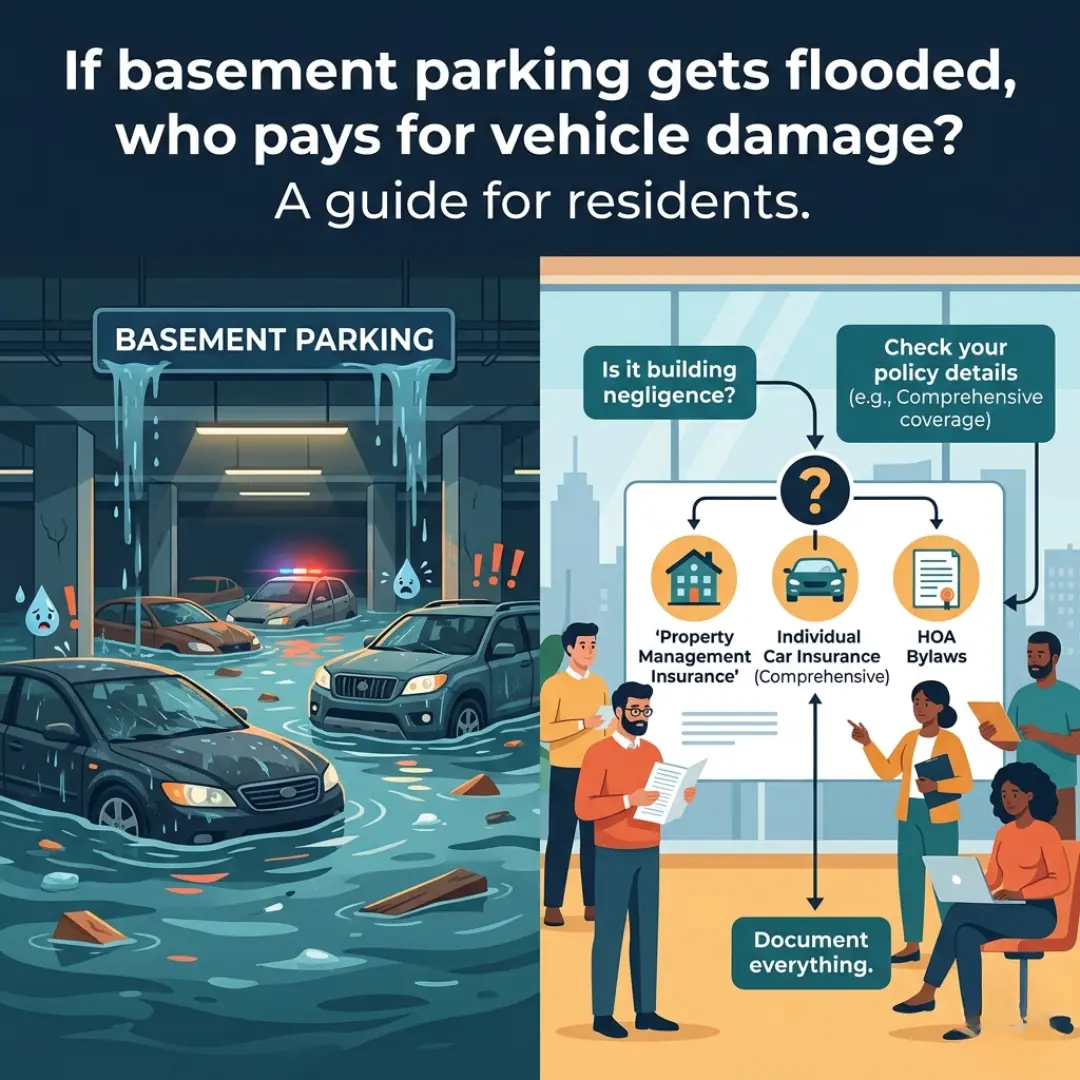
Picture this. It has been raining relentlessly for two days. The weather forecasters look genuinely worried, and your WhatsApp groups are flooded with videos of submerged roads. You wake up on the third morning, the sky has finally cleared, and you grab your car keys to head to the office. You take the elevator down to the basement, the doors slide open, and your heart completely stops. The basement isn’t a basement anymore; it’s a murky, swirling swimming pool. And right in the middle of it, sitting silently in three feet of rainwater and sewage, is your car. In that exact, paralyzing moment, determining Car damage responsibility becomes your only thought. How did this happen? Why didn’t the pumps work? Most importantly, who is going to pay for this nightmare?
The Emotional Toll of a Submerged Car
Before we talk about insurance policies and legal jargon, let’s acknowledge how awful this feels. Your vehicle isn’t just a piece of metal. For many of us, it’s the second most expensive thing we buy in our lives, representing years of savings or a hefty loan. Seeing it submerged triggers a deep, boiling anger. Immediately, you look for someone to blame—the helpless security guard or the resident welfare association (RWA) committee members. Naturally, you want someone to write you a check on the spot. But understanding who actually holds the Car damage responsibility requires taking a deep breath and looking at how the law actually works.
Nature vs. Negligence in Apartment Basement Flooding
When Apartment basement flooding occurs, the immediate reaction is to storm into the management office and demand compensation. It seems logical, right? After all, you pay maintenance, so the society must be liable. However, the law views it differently. To figure out Who pays for car damage in floods, we must determine why the water came in.
Let’s look at the “Act of God” scenario. If your city received unprecedented rainfall, the local drains overflowed, and stormwater backed up into your basement, this is legally considered a force majeure event. In this scenario, sorting out Car damage responsibility becomes incredibly tricky for residents. The housing society is generally not held legally liable because they didn’t cause the rain, and the volume of water exceeded what any reasonable design could handle.
Conversely, what if it rained normally, but the basement flooded because the sump pits hadn’t been cleaned in two years? If the heavy-duty water pumps were broken due to ignored warnings, the dynamics shift entirely. Here, the Housing society responsibility becomes paramount. Proving that the flooding was caused solely by gross negligence in upholding their Building maintenance responsibility allows residents to potentially sue the society for damages.
The Uncomfortable Truth About Legal Battles
This is where things get incredibly complicated. Even if you strongly believe the management was at fault, proving it is a long, expensive legal battle. You would need to hire engineers to prove the pumps failed due to neglect, not a power grid failure.
Because of this complexity, almost all standard apartment agreements explicitly state that Car damage responsibility in a basement rests on the vehicle owner. When you buy a parking spot, the agreement clearly states that the society is merely providing a “space to park.” It is not providing a “guaranteed waterproof vault for your vehicle.” It feels incredibly unfair when you are standing there looking at ruined upholstery. However, accepting this reality is the first step toward actually getting your money back, rather than wasting three years fighting a losing battle in consumer court.
Your First Line of Defense: Comprehensive Insurance
If the housing society probably won’t pay, where do you turn? You look at the document you probably tossed into your glovebox: Your Car Insurance Policy.
Understanding Vehicle insurance coverage flood is the single most important thing you can do as a car owner. There are two main types of policies in India. Third-Party Insurance is mandatory but only covers damage you cause to others. It pays exactly zero rupees if your own car is damaged by a flood.
What you need is a Comprehensive Insurance policy. This covers your vehicle against theft, fire, accidents, and crucially, natural disasters like floods. If you only have third-party coverage, the Car damage responsibility falls 100% on your own shoulders.
Maximizing Your Car Insurance Flood Damage Claim
Having comprehensive insurance is great, but most standard policies have a “depreciation” clause. This means the insurer will deduct a percentage based on the age of your car and the damaged parts. Rubber and plastic parts depreciate faster than metal. To avoid this out-of-pocket loss, you should have a “Zero Depreciation” add-on cover. With this add-on, the insurance company will essentially pay the entire cost to repair your car to factory condition, minus a small voluntary deductible.
Navigating Car insurance flood damage claims is common in India, but you must follow the rules. Never try to start a submerged car. Doing so will force water into the engine, causing hydro-lock, and the insurer will instantly reject your claim. Document everything with photos and videos, inform the society in writing to preserve CCTV footage, and call your insurer immediately.
Understanding Property Insurance Claims vs. Personal Claims
While you are dealing with your vehicle, the basement itself is a disaster. The lift motors might be wet, electrical ducts are short-circuited, and walls are ruined. This is where Property insurance claims come into play.
Every well-run housing society should have a comprehensive policy covering the building’s structure and common areas. The management committee must immediately intimate the insurer about the Parking area water damage. The insurer will send a surveyor to assess the damage to the building’s pumps, wiring, and walls. Crucially, you must understand that the society’s insurance covers the building’s damage, not your personal property. Your car is considered your personal property, so the society’s building insurance will not pay for it.
Knowing Your Resident Rights in Apartment Flooding
Even if the society isn’t going to buy you a new car, you still have specific Resident rights in apartment flooding. First and foremost is transparency. The RWA must provide you with the maintenance logs for the basement pumps and drainage systems upon request.
Additionally, you have the right to demand an emergency general body meeting to question why the Building maintenance responsibility was not fulfilled. You have the right to vote to remove a managing committee if they were grossly negligent. Furthermore, you have the right to ensure that your Flood damage compensation claim is processed fairly. The society must cooperate with your insurance surveyor by providing CCTV footage and access to the basement. Deliberately obstructing your claim is a legal offense.
The Builder’s Role in Flood Prevention
People often ask if they can sue the builder. If your building is relatively new and still under the defect liability period (usually 5 years as per RERA), the answer might be yes. Should the basement flood because the builder used undersized drainage pipes or built below the municipal stormwater drain level without adequate pumping capacity, the Car damage responsibility could partially shift to the developer. Proving construction defects versus an unprecedented natural calamity, however, requires massive forensic engineering audits.
Why Prevention Beats Cure: The Globes Properties Approach
At Globes Properties real estate, we spend an unhealthy amount of time thinking about water. We know that reading about Who pays for car damage in floods is stressful. Fighting with insurance companies and RWAs is a nightmare no family should endure. Because of this, our approach at Globes Properties Bangalore is simple: We engineer the problem out of existence.
When we design our buildings, our engineers map out the topography of the entire surrounding area. We calculate run-off coefficients and design stormwater management systems that handle 150% of the highest recorded rainfall. In our projects, we want Car damage responsibility to be a non-issue because we ensure the water never reaches your bumper. We use industrial-grade submersible pumps with auto-float switches and diesel generator back-ups. We install non-return valves so city sewage cannot backflow into our parking areas.
Spotlight on SLV Sunshine: Engineered for the Monsoons
Let me give you a perfect example of this philosophy. Our project, SLV Sunshine, is located in the beautiful Jakkur area of North Bangalore. While Jakkur is famous for its lush greenery and the iconic lake, areas with water bodies are historically susceptible to water logging during heavy spells.
When we planned SLV Sunshine, we engineered for the monsoons aggressively. Before pouring concrete for the basement, we spent months on hydrological studies. We elevated the entire stilt level and basement floor significantly higher than the adjacent road level and the historical high-water mark. Even if Jakkur’s roads flood, the water has to climb a steep incline to reach our basement. Furthermore, the basement drainage isn’t just a pipe leading to the street. We built dedicated sump pits with high-capacity pumps that actively push water uphill into municipal drains. By designing these fail-safes, we completely remove the stress of Car damage responsibility from the homeowner’s mind. For those looking at Globes Properties apartments, this level of engineering is our standard. Across all Globes Properties projects in Bangalore, our water management specs are two steps ahead of local building codes.
Questions to Ask Before You Buy
When you are out house hunting, it is easy to get distracted by beautiful model apartments and manicured lawns. I urge you to look deeper. When you evaluate Globes Properties flats for sale or any other property, ask to see the basement.
Ask the sales team where the stormwater drains exit the property. Inquire about the horsepower of the dewatering pumps and whether they are connected to the backup generator. Ask about the elevation of the basement compared to the road outside. If the salesperson looks confused, that is a massive red flag. It means years down the line, you might be the one standing in ankle-deep water, fighting a frustrating battle over Car damage responsibility.
Conclusion: Peace of Mind is the Ultimate Luxury
Living in an apartment should make your life easier. It should free you from the burdens of maintaining a standalone house and provide a safe environment. The moment you worry about your car drowning in your own building’s basement, that trust is broken. Navigating Vehicle insurance coverage flood clauses and fighting for Resident rights in apartment flooding drain your soul. At Globes Properties Bangalore, we want you to enjoy the monsoons. We want you to sit on your balcony at SLV Sunshine, sip hot chai, and feel absolutely zero anxiety about what is happening three floors below you. We took care of the engineering so you never have to worry about who pays for a flooded car.
For More Visit : https://globesproperties.com/
Powered By: https://mnmreality.com/




Join The Discussion